
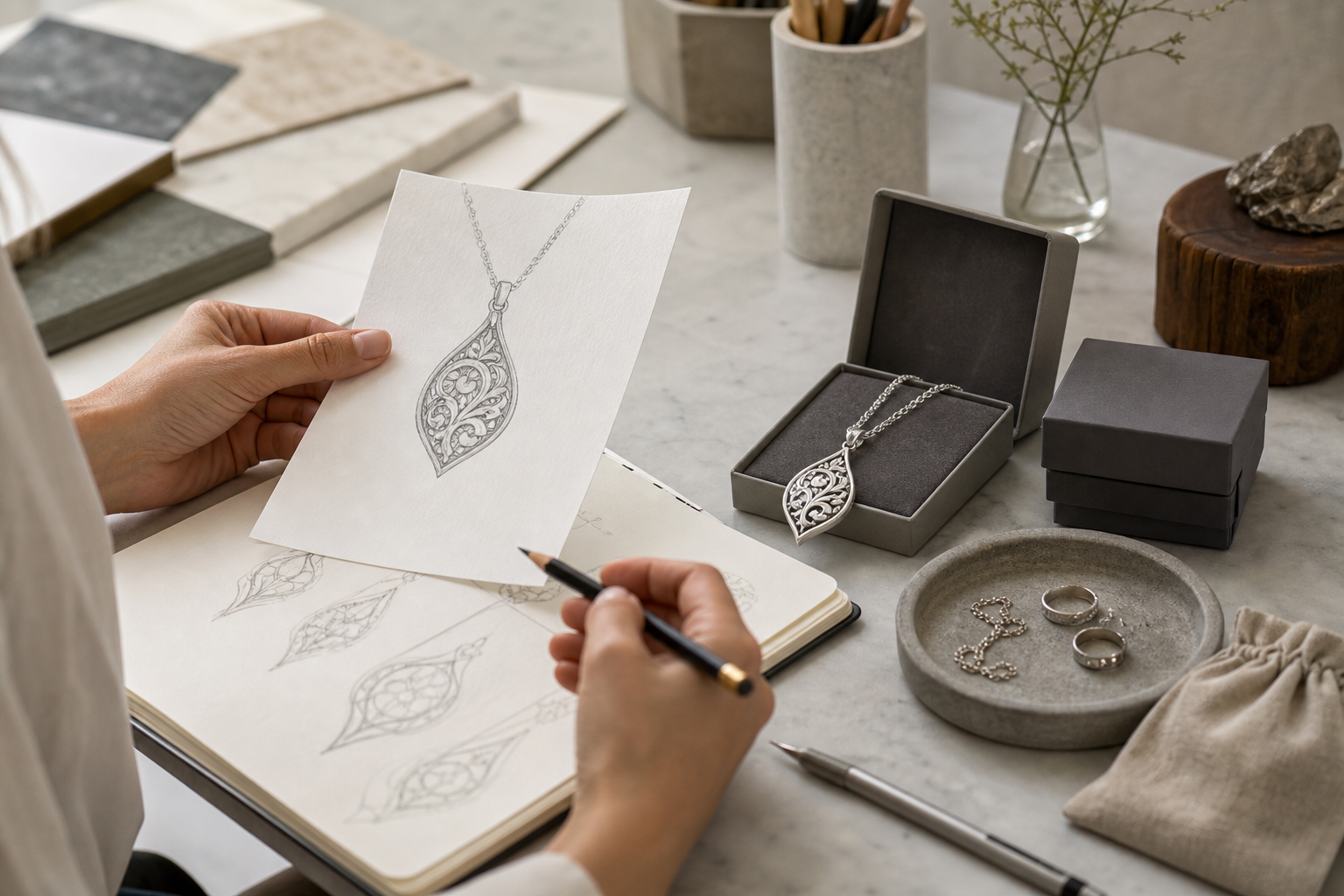
Wholesale Silver Jewelry Catalog Attributes: What Buyers Need on Every SKU
A wholesale silver jewelry catalog should help a buyer decide what to sample, what to order and what can be reordered later. Product photos create the first impression, but catalog attributes make comparison possible. When every SKU follows the same information structure, retailers can review rings, necklaces, bracelets, earrings, pendants and finished accessories without repeatedly asking for missing details. This guide explains the fields that make a wholesale catalog more useful for B2B purchasing and private label planning.
Start with a catalog that answers buying questions
Retail buyers usually need to compare product type, dimensions, approximate weight, material, finish, quantity, packaging and availability. A catalog that shows only a photo and a product name creates extra messages and slows the decision. A practical catalog does not need to publish every commercial term publicly; it does need to make clear which information is confirmed, estimated, or available after a project-specific quote.
For a custom 925 sterling silver manufacturer, the catalog may contain both finished accessories and development directions. Mark these clearly. A ready-to-review product, a repeatable base design and a fully custom concept do not have the same lead time or quotation process. 925 Pro can support wholesale silver jewelry sourcing and custom development from Haifeng, Guangdong, with MOQ starting from 30 pieces per design.
- Product name and SKU
- Product category and design family
- Material and component notes
- Finish or plating description
- Quote or availability status
Use a stable SKU and naming system
The SKU should be short, unique and stable enough to connect the catalog, sample, packaging, order record and future reorder. Keep the customer-facing product name separate from the internal code. A product may be called “Aurora Oval Pendant” in the catalog while the production record uses a compact SKU. If a finish, size or construction change creates a different sellable item, record that variation instead of silently reusing the old code.
A catalog becomes difficult to manage when the same design receives a new name in each file. Use one primary name, one SKU, one approved image set and one version note. If a design is still under development, add a development status and do not present its dimensions or finish as final. This protects the buyer from ordering against an outdated reference and helps the factory keep revisions organized.
- Collection code
- Product type code
- Design sequence
- Finish or size suffix when needed
- Version or approval status
Record material and finish with careful wording
Material fields should distinguish the main body, components and surface finish. For example, a product may use 925 sterling silver as the base while including a chain, post, backing, stone or plated surface that needs separate discussion. “Gold” alone is not a complete finish specification. State whether the item is silver finish, gold plated, rose gold plated or another project-specific option, and confirm thickness or color expectations during sampling.
Avoid unsupported claims such as guaranteed lifetime wear, universal hypoallergenic performance or compliance in every market. 925 Pro can discuss available quality documentation and compliance-related requirements, but the exact product, components and destination market should be confirmed. A careful catalog is more credible because it shows what is known and directs buyers to ask for what needs project-level verification.
- Base material
- Component material
- Plating color and surface finish
- Testing or documentation status
- Care or labeling note when applicable
Make dimensions and weight useful for comparison
Dimensions should follow a consistent order. A ring may need band width, top length, thickness and size range. A necklace may need chain length, pendant height, width and bail size. Earrings may need drop length, width, post length and pair weight. Bracelets may need inner circumference, opening, width and closure dimensions. Use millimeters or another agreed unit, and never mix units without a clear label.
Weight is often approximate until the sample and final construction are confirmed. It can change with size, hollow or solid construction, stone setting, polishing and plating. Present it as a target or estimate when appropriate. For quotation, the manufacturer needs the design, size, shape and weight information together because these factors can influence sample fees, mold fees and production cost.
- Use one unit system
- Define measurement points with a drawing or photo
- Show target versus confirmed values
- State whether weight is per piece or per pair
- Record size ranges and variations
Include MOQ, sampling and lead-time fields
Wholesale buyers need to know whether quantity is calculated per design, per finish or across an order. 925 Pro’s standard starting point is 30 pieces per design, with the final production structure confirmed for the project. Sample and mold fees depend on the specific dimensions, shape and weight. Minor revisions based on the submitted reference are generally manageable within two small rounds; major changes may require new sampling or a new quotation.
Lead time should be split into stages. Standard production is usually 5–20 days after sample approval. Sampling, internal brand approval, packaging production and shipping are separate planning items. A catalog can use fields such as “sample status,” “production timing after approval,” “packaging status” and “shipping method to confirm” instead of presenting a single date that may be misunderstood.
- MOQ per design
- Sample and mold fee status
- Revision note
- Production timing after sample approval
- Packaging and shipping status
Build filters that match retail decisions
If the catalog is digital, filters should reflect the way buyers shop. Useful filters may include product type, collection, material, finish, price position, size range, stone or no stone, logo option, packaging option and development status. Avoid creating dozens of thin filters that contain one product. A filter is useful when it helps a buyer compare a meaningful group of products.
Attributes should be written consistently so a search or filter does not split the same concept into several spellings. Decide whether the catalog uses “rose gold plated” or “rose-gold plated,” “earrings” or “earrings / studs,” and keep that choice across products. Consistency improves the buyer experience and supports the site’s internal search and category structure.
- Product category
- Finish
- Collection
- Development status
- Packaging and logo option
Connect catalog data to the quote workflow
A catalog should lead naturally to a quote or sample request. Add a clear action such as “Request details,” “Inquire about this SKU” or “Add to RFQ.” The inquiry should carry the SKU, product name, target quantity and any selected finish into the conversation. This reduces the chance that a buyer sends a screenshot without enough context or that the factory quotes the wrong variation.
For a custom project, the quote form should allow a sketch, reference image, product link, dimensions, material, plating, logo, packaging, quantity and target delivery date. If some fields are unknown, the buyer can say so. The purpose of the catalog is not to force a buyer to have every answer; it is to make the known information easy to transfer and the open decisions visible.
- SKU included in every inquiry
- Selected finish and quantity
- File upload or reference link
- Packaging and logo notes
- Destination and target date
Catalog QA before sending it to buyers
Review the catalog as if you were placing a reorder six months later. Can you identify the approved sample? Can you tell which image shows the correct finish? Are dimensions measured from the same points? Is the quantity per piece, pair or set? Does the product page make clear whether the item is finished stock, a base design or a custom development route? These checks find problems that a spelling review will miss.
Use a short release checklist and give each catalog version a date. Confirm images, alt text, filenames, internal links, category names, SKU values, material wording and inquiry buttons. When a product changes, update the catalog, sample record, packaging artwork and production file together. This is particularly important for private label brands that need the online listing to match the physical shipment.
- All SKUs unique
- Images match the current sample
- No missing material or finish fields
- MOQ and timing language is accurate
- Quote links and contact details work
FAQ: wholesale silver jewelry catalogs
Should wholesale catalogs show prices?
Prices can help with initial filtering, but custom jewelry pricing depends on size, weight, finish, quantity, tooling and packaging. A catalog can show a price position or invite a project-specific quote when the product is not a fixed item.
What is the most important catalog field?
There is no single field for every buyer, but SKU, product type, material, dimensions, finish, quantity and status together create a usable minimum. Missing information forces buyers to ask before they can compare.
Can one catalog include finished accessories and custom products?
Yes, if the product status is clear. Finished accessories, standard base designs and fully custom concepts should be separated or labeled so the buying process and timing are not confused.
Plan your next step
Use this guide alongside our related 925 Pro service guide, review the relevant custom jewelry development option, or request a custom jewelry quote with your design, quantity and finish requirements.
About the 925 Pro editorial team
This article is prepared by the 925 Pro editorial team in Haifeng, Guangdong. The 925 Pro project launched in 2024 and is supported by 16 years of jewelry industry experience. Product, compliance, packaging and delivery details should be confirmed for the specific design and destination market.
Project review: Send a custom jewelry brief or contact liam@925pro.com and WhatsApp / phone +86 198 7273 8776.
Related 925 Pro resources
Custom Silver Rings · Custom Silver Necklaces · Custom Silver Bracelets · Custom Silver Earrings · Wholesale Silver Jewelry · Custom Jewelry Manufacturing · Private Label Jewelry · Materials & Quality · Shipping & Returns · Get a Quote